Friday, November 12, 2010

Happy Friday!

This week seemed to "fly by" - thanks to a day off on Thursday.  I hope you all remembered to think of and thank a Veteran yesterday for their dedication to our country. 

Despite the short week, we have been very busy in Room 13.  Keep reading for an overview of this week's work! (Hopefully, this information will provide you with a little "fuel" for dinner conversation!)

Reading
The focus in reading this week was on plants. The main selection in our reading books was Eric Carle’s story The Tiny Seed, which describes the journey of a little seed as it travels to “find” a place to grow. The students learned some very interesting facts about seeds and plants through this story. Ask your child why it was good for the seed to be so tiny!

Eric Carle has quickly become a "favorite author" of students in our classroom.  Encourage this by checking out some more of his books from the library and/or from the bookstore.  After just a few pages, you will understand why children love his stories so much!!

The reading comprehension skill/strategy for this week was drawing conclusions. The children had to use information gathered from the story (from words and/or pictures) and use it to draw conclusions about plants and seeds. As with most of our comprehension skills, this can be tricky at times and we will continue to work on it throughout the school year.

Since we had such a short week we deviated slightly from our regular reading center routine. Students were asked to complete the following 3 reading activities:

Art:  In this center, students practiced writing sentences in which they list things – and separate each item with a comma (using commas in a series). Each student wrote 3 sentences, each of which contained 4 items. They then separated each of these items with macaroni (in place of commas) and illustrated their sentences.

Grammar:  The grammar center focused on differentiating between common and proper nouns this week. Students completed several activities addressing this concept.

Phonics:  Students used the Phonics Linking Cubes set to create 4 different short u “word families” (with 4 words in each family). They then chose one of their words and used it to write 1 complete sentence.


Spelling
This week, our spelling list focused on short u and the u_e pattern. This pattern creates a “long u” sound. The _ (underscore) represents a consonant. Words that follow this pattern include:

       rude    confuse   sure    flute    fume    June

This can be tricky because many words that have the long u sound are actually spelled other ways! (Examples: school, blue, knew) Yikes!


Grammar & Writing
1. As students already know, nouns name people, places, and things. Nouns can be further classified, however, as common nouns and proper nouns. This week, students worked hard to differentiate between the two.

Common nouns name everyday, regular things.
Examples: girl, ocean, cat

Proper nouns are those nouns that name specific people, places or things.
Examples: Suzy, Pacific Ocean, Fluffy

Proper nouns are always capitalized because they are special. Common nouns are NOT capitalized (unless they begin a sentence).


2. We have also been working on using commas in a series. Students should understand that commas are used to separate 3 or more items in a list.

Example: I like apples, oranges, bananas, and pineapples.


I hope to see them start applying this knowledge in their writing!


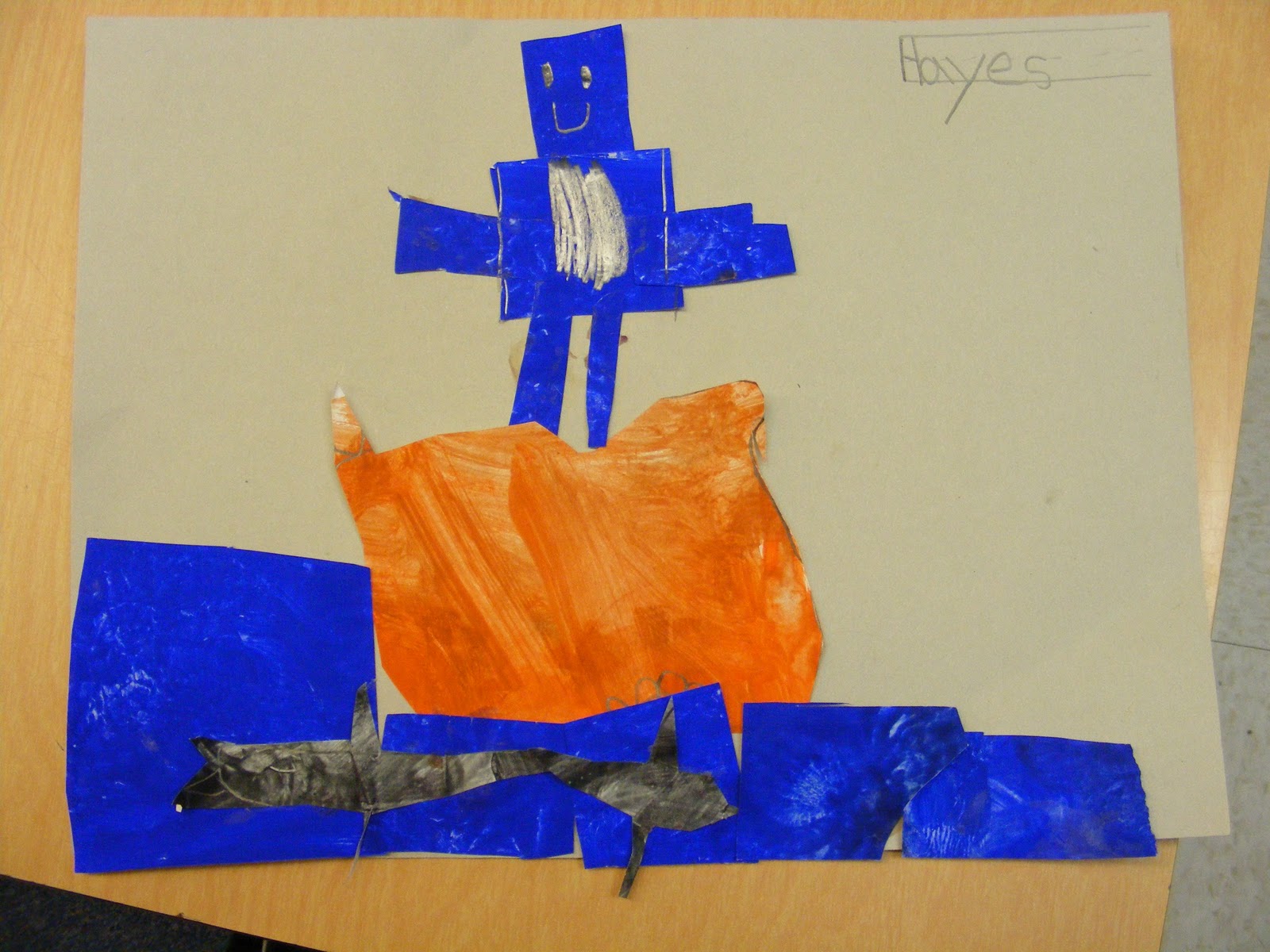
Awesome Art Activity:  Eric Carle Art
We have been reading his stories and studying his art and it's unanimous - we love Eric Carle!  After watching him create several of his original collages (on video) we decided to give it a try ourselves!  Students are currently drafting their first personal narrative and we thought it would be a great idea to create a collage to accompany each story! Take a look below to see students as they go through the process:


And here are a few examples of finished collages:


Aren't you impressed??


Math
On Monday, students worked together to collect and graph data! Students first determined how many pockets they had that day. Then, we recorded all the data and created a bar graph! Through this activity, students were introduced to the concepts of median (the middle value) and mode (the most frequent value). These are some fairly “grown-up” concepts – don't you think??

Later in the week, students were introduced to the concept of making change. This is a very difficult concept for children – and one that needs frequent review. I have noticed that some students have a difficult time understanding that they should even GET change back when they pay too much!! (If you think about it, most of us pay with credit cards and/or debit cards and students never see change being given for purchases!)

For adults, the easiest way to make change is to just subtract the amount that you owe from the amount that you paid. Many of us are able to do this easily in our heads or on paper. This is a much more difficult task for children, however. At this point in the year, we have not talked about or learned how to subtract multi-digit numbers – and I do not expect students to use this method to find change.

Students have learned that they can find change by counting up from the amount that they owe to the amount that they paid – and they keep track of this difference by drawing the coins that they used to count up.

Example: David buys a toy for $0.65. He pays with a dollar. How much change does he get back?

Here are the steps we follow:

1. “Put 65 in your head.” (Start with 65)


2. Count up to a dollar.
65  + D + D + D + N  = $1.00
(I counted: 75 85 95 100)

3. Now, add up the coins you drew:
D + D + D + N = 35


4. David receives $0.35 in change.

Students can also count BACK from the amount that they paid to the amount that they owe – but this is a lot trickier and most students get tripped up just counting backwards, so it’s not a strategy I recommend at this point in the year.

Whatever method your child chooses, please help him/her by providing LOTS of opportunities to practice.  This is a difficult concept and requires a lot of review! 

Social Studies

We began our first Social Studies unit this week – Maps and Globes. As you can imagine from the title, students will be learning all about maps and globes in this unit. As discussed in class, a map is a picture that shows us a place. It can be anywhere/anything – your classroom, house, bedroom, solar system, body, etc! A globe is a 3-D model of the earth. We had a great discussion this week identifying the differences between maps and globes, as well as the advantages and disadvantages of each. Ask your child about it!


Mystery Reader
Our Mystery Reader this week was Henry's dad!  Mr. Edwards read us a wonderful story by Dr. Seuss titled, The Butter Battle.  This story not only followed the wonderful rhyming pattens Dr. Seuss is known for, but it contained a very important lesson for readers about respecting others' opinions and traditions.  Thank you so much, Mr. Edwards, for spending time with us in Room 13!


Friday, November 5, 2010


Conferences
Parent-teacher conferences are well under way! I have really enjoyed talking with so many of you and I look forward to meeting/seeing the rest of you in the next few weeks! Please remember that I can always be contacted via email or phone if you have any further questions or concerns about your child! I want to make sure that we are always on the same page and working together to ensure students’ success!


Keep reading for an overview of our week in Room 13:

Reading
This was a review week for us in reading. We did not read a new story in our anthology, but instead reviewed all the important spelling rules/patterns (short and long vowels), grammar skills (punctuation, different kinds of sentences, nouns, past-tense verbs, subjects/predicates), reading comprehension strategies (identifying characters and setting, making predictions, describing main idea/details), graphic organizers (T-charts, beginning/middle/end flowcharts), vocabulary, and writing skills. Whew! We have been very busy!


On Thursday, students had the opportunity put this knowledge and understanding to good use as they worked to complete the Unit 1 reading assessment.

Spelling
As with reading, this week’s spelling list was also review. Students’ lists consisted of words with short and long vowels (with the “sneaky e”). The format of the spelling test was a little different this week, however, and will be for review weeks. Instead of writing words in isolation, students were asked to complete a dictation – writing full sentences as they are read by the teacher. This kind of assessment demonstrates students’ ability to pull together all their knowledge of spelling, capitalization, and punctuation. The ultimate goal of spelling tests is for students to APPLY their knowledge of spelling rules/patterns more consistently in their everyday writing. I hope that these dictations will help them get used to this!


Grammar
This week, we learned more about past-tense verbs. Students should now know that most (but not all) past-tense verbs end with –ed.


Many verbs can be changed by simply adding –ed.
      Example: walk --> walked

Verbs that already end with “e” can be changed to past-tense by just adding –d.
      Example: smile --> smiled


Other verbs are a little trickier. Verbs that follow the consonant-vowel-consonant (cvc) pattern and have a short vowel sound usually must have the last consonant doubled before adding the –ed (to keep the vowel short).
      Example: trip --> tripped

Since students are familiar with “sneaky e,” I explain this rule as follows:
When “Sneaky e” is at the end of a word, it can hop over 1 letter. If the letter it lands on is a vowel, it makes the vowel say its name (the long vowel sound).

If you want a short vowel to stay short when you add –ed, check to make sure that the “sneaky e” can’t hop over and make the vowel say its name.
      Example: hop --> h o p e d    OOPS!
            
If “sneaky e” can make the vowel say its name and you don’t want it to, you need to double the last consonant to “block” it!
      Example: hop --> h o p p e d


Of course, there are always exceptions and we will learn about irregular verbs in a few more weeks. For now, however, students should work to apply these rules to their own writing…please encourage this!


Math
As mentioned last week, Unit 3 begins by reviewing and expanding upon some basic math concepts, including place value, time, and money. This week, we focused primarily on time and money.


Time – I have noticed that some children still “mix up” the hour and minute hands on the analog clock. With all the digital clocks everywhere (on the microwave, in the car, etc.), it’s hard for students to understand why they need to learn how to tell time on an analog clock. Please encourage them to use an analog clock whenever possible! (A watch is a great gift idea…) 


Money – At this point in their academic careers, students should be able to quickly and accurately identify coins (front and back) and their values. Students should also be comfortable with combining coins and determining the total values. The only way to solidify this understanding is through practice! I will continue working with money here at school … and I would greatly appreciate it if you could do the same at home!


On Friday, we had another math lab. With the help of some great parents, students reinforced their understanding of time (making clock booklets), and place value (creating place value kites and playing Dino Math Tracks). Take a look below!


Science
We wrapped up our first Science unit this week:  Properties of Matter.  Students had a chance to show off what they knew on the end-of-unit assessment - and they did a great job! I'm hoping that students will remember most of the fun experiments and activities we did for years to come! :)  And now, it's off to Maps & Globes...


Mystery Reader
Our Mystery Reader today was Julie's mom! She read two wonderful stories:  The Marshmallow Incident by Judi Barrett and Something From Nothing by Phoebe Gilman.  Students were thrilled, as always, to have a guest in the room and really enjoyed listening to these stories.  What a wonderful way to end the week - thank you, Mrs. Chambers!


We have been keeping busy here in Room 13…and I bet you have been doing the same at home!  With all the hustle and bustle – games, practices, meetings, etc. – it’s a good idea to check in with your child.  How was his day?  What did she learn today?  This will help you stay connected with your child and with our classroom! J

Monday, November 1, 2010

"What's the Matter?"

Today we had a special visit from a real scientist!  "Jungle Jeff," a scientist from the High Touch-High Tech science program came to teach us more about matter!  After reviewing all the wonderful information students already knew about matter, Jungle Jeff engaged the children in a number of exciting, hands-on activities and experiments.  Through these activities, students reinforced their understanding and knowledge of properties of matter, types of matter (solids, liquids, and gases), and the molecules that make up matter.  Look at the pictures below to see students having fun while they learn!